
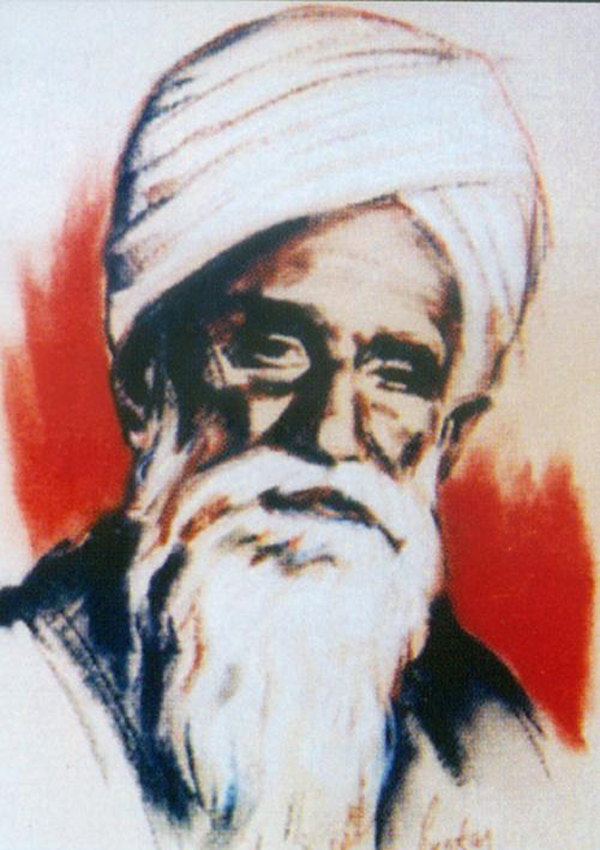
Discussion: Remembering Ghadari Babas, the Unsung Heroes of the Indian Struggle for Independence
Aug 30th
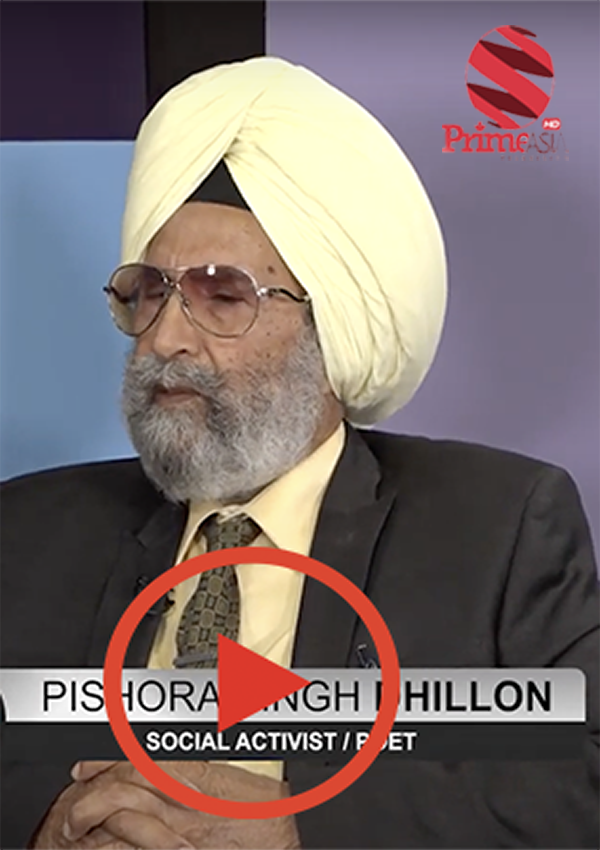
Tune in to KBIF AM 900 every Sunday between 3-4pm (PST) to listen to Punjab News and Views.
Don’t have a radio? Listen to it live at www.asianradioam.com
Download and listen to any of the radio shows at your leisure by subscribing to the podcast at http://www.punjabnewsandviews.com/radio/JasPodcast.rss
This week’s topic: Remembering the Ghadari Babas
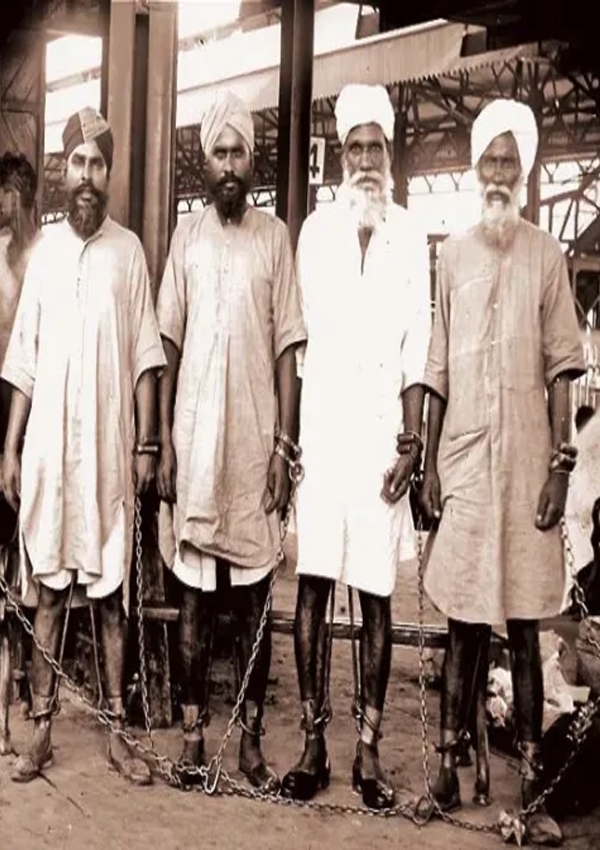
Every nation has a history and a story of their patriot warriors who at one critical juncture or another of a dire need, had stood up to the tyrant to be counted, fought and had sacrificed their all to protect its freedom and foster its nationhood. Years later, in national celebrations and thanksgivings however, only those few are remembered who somehow find a place in its history books and thus in peoples’ minds; others remain unknown, ignored or forgotten as the time goes by. Ghadri babas affectionately known as the elderly revolutionaries appear to have met a similar fate in India’s history books and consequently in peoples’ minds.

The Indian Flag
These elderly revolutionaries had sacrificed their all, not only fighting for Indias’ freedom alone but equally importantly to reclaim its nationhood as one Indian nation lost under the 200 years of the ‘Divide and Conquer British Rule’. Although it all began here in California, not many Indians, especially the younger generation now living in California as free citizens knew or much cared about them either. This is not to say that left of the center political parties in India, mainly the communist parties did not keep the torch alive; they did but the Ghadri babas were hardly mentioned in the national celebrations by the ruling governments where they deserved their rightful place and where it really mattered.
Interestingly a century later, there are now a number of Indo – U.S. organizations which have been organizing meetings dedicated to the Ghadrites in some of the major Californian cities starting in Fresno followed by Sacramento and San Francisco, where the Ghadrites mostly met and where the story began.
Read my previous article, “Legacy of the Ghadarites” for background on their achievements.
It is a story where ordinary Indian laborers working in north America in the early 20th century, led by a handful of Punjabi Sikh revolutionaries all became Ghadrites, a name later taken after their newspaper ‘Ghadar’ they had started to publish from their headquarters, Yogantara Ashram in San Francisco. The story of the Ghadri babas is worth knowing for all Indians as a nation, be they from the east, west, north or south of India; for residents and NRIs’ alike.
Ghadri Babas, also known as Ghadrites for short, had sacrificed everything they had, including their lives, not only fighting for India’s freedom from foreign rule, but equally importantly to foster its nationhood as one Indian nation. While the British used the strategy of “divide and conquer,” the Ghadri Babas used it in reverse and unified Indians regardless of their regional, religious, or linguistic ties. In so doing they not only challenged Indians to oust the British by force from India but more importantly fight them under a one Indian banner.
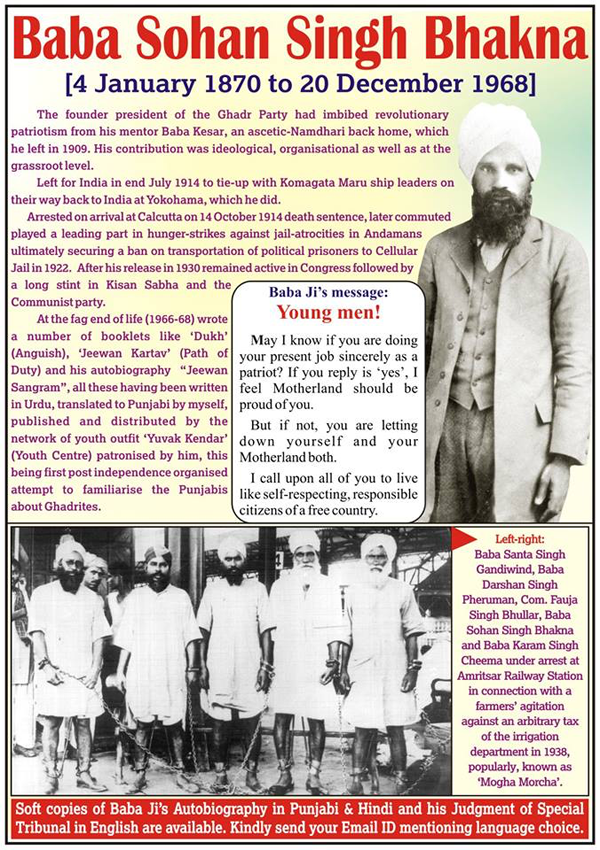
While Indians who were in North America during this time were predominantly Punjabi Sikhs and the movement was propelled by a handful of Punjabi Sikh revolutionaries, all Indians, regardless of their backgrounds joined forces to become one revolutionary entity, the Ghadar Party. It didn’t matter to them that Baba Sohan Singh Bhakna was Sikh, Mahomed Barakatullah was Muslim, Lala Hardyal was Hindu, or that Tarak Nath Das had regional and linguistic ties to Bengal. Having played a crucial role in the Indian Independence movement , the story of these Indian revolutionaries rising above religion, regionalism, ethnicity, language, cast or creed for a common cause to rid India of foreign rule, is worth knowing for all Indians, no matter what subdivision they have created for themselves. The bottom line is that regardless of anything else, all Indians are Indians and have India’s best intentions at heart.

Indian Independence Day Celebration in Fresno, CaliforniaHarry Gill, Linda Haldermann, Mike Villines and Me
It is encouraging to see that this recent phenomenon of remembering and bringing these unsung heroes into focus started in the central valley California is now gaining momemtum. Just a few days ago, I attended an Indian Independence Celebration in Fresno put on by both Hindu and Sikh organizations. And just before that the Ghadar Memorial Foundation of America held a meeting in Sacramento attended by Californians from all over the state which included half a dozen distinguished intellectuals, who travelled all the way from Punjab. These included Dr. Manjit Singh Kang, Vice Chancellor Punjab Agricultural University Ludhiana and the widely respected journalist and diplomat Kuldip Nayar who presided over the conference and was also the Keynote speaker. He wrote an article, “The Ignored Revolutionaries: How They Contributed to India’s Freedom” was published in the Tribune detailing his experience there.
Also dedicated to the awareness for Ghadrites, the Indo-US Heritage Association Fresno is organizing a ‘Mela’ in the Fresno Fairgrounds on Sunday August 29, 2010. TV Sadda Channel CEO, Sidhu Damdami will be the Keynote speaker.
Popularity: 9% [?]
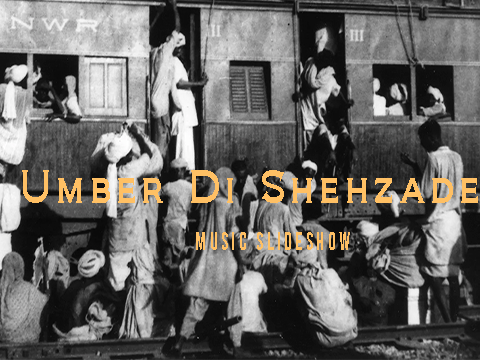
Kavita Di Kahani: Umber Di Shehzadi Nu (to the Princess of the Skies)
Aug 26th
I am not aware if each kahani has a kavita behind it, but each kavita appears to have something to do with some kind of a kahani. Below is the Moving Image of “Umber Di Shehzadi de Naa: To the Princess of the Skies,” a kavita I wrote 41 years ago and which I recently set to images and my voice. This is the story of that kavita.
I first came up with the idea for Umber Di Shehzadi during the dead of the night in the rented front room of BDO, a friend and class fellow from Khalsa College, Amritsar, who was living in Southall, London.

Khalsa College, Amritsar
There were about half a dozen of us, all classmates from the same year of Khalsa College Amritsar, who by the quirk of fate immigrated to the UK in a span of a year or two of each other during the late 1960s. We all found our first jobs in factories or bakeries. And we were all single. That meant that over the weekends, we had no other obligations, and would often get together at each other’s rented one-room accomodation. (none of us, fresh arrivals from India, owned homes yet).
That particular evening, we were all there to witness a historic moment: to watch the first human walk on the Moon. The Apollo 11 space flight landed the first humans on Earth’s Moon on July 20, 1969. The mission, carried out by the United States, was considered a major accomplishment in the history of exploration and represented a victory by the U.S. in the Cold War Space Race with the Soviet Union.
BDO’s real name was Surain Singh Sandhu belonging to Dibbi pura, a village on the border of Pakistan in district Amritsar, but we all called him BDO because before moving to England, he used to work as a Block Development Officer in Punjab. And this designation stuck (and he liked it) even though, after moving to England, he worked as a machine man in a factory making steel ropes for the shipyards in Middlesex and then as a postman in the main Post office in London.
On this special evening, BDO entertained us with a deliciously cooked chicken served with English Cream Sherry and as usual his Punjabi landlady prepared the rotis for us. Wise desi landladies in those days used to let us single people cook our own daal, sabzi, and meat, but would not trust us with making rotis in the shared kitchen. They would politely offer to make and supply rotis free of charge because as much as we thought we were quite the experts in the kitchen now, we would make such a mess by spilling and spreading wheat flour all over the shared kitchen during kneading the dough. So they figured it took the same amount of effort to cook the rotis as it did to clean it all up later, especially from the hidden spaces around the cooking area.
As we sat glued to the BBC, an announcement came on telling us that the program would be delayed by a few hours from the time originally stated by the U.S. network, CBS News. We tried unsuccessfully to take a little nap in between, but remained very excited as the moment began to move closer to midnight, the expected landing time in London.

Neil Steps on the Moon
When it finally came on the television screen, we were mesmerized and hung on every word: Launched from Florida on July 16, the third Lunar Mission of NASA’s Apollo Program was crewed by Commander Neil Arden Armstrong, Command Module Pilot Michael Collins, and Lunar Module Pilot Edwin Eugene “Buzz” Aldrin Jr. On July 20, Armstrong and Aldrin landed on the spot they named ‘Sea of Tranquility’. Identifying themselves as having landed at the newly made up name ‘Sea of Tranquility’ Neil Armstrong baffled the CBS News broadcaster back in the USA momentarily, who I think was Walter Cronkite, before he could fully comprehend what was going on. From a small one-room apartment in Southall, my friends and class fellows of Khalsa College, Amritsar and I watched Armstrong and Aldrin become the first humans to land and walk on the Moon. The magnanimity of what we had just seen is still fresh in my mind.
As soon as their space ship, “Eagle” touched down, we sat there speechless. Then we saw Neil Armstrong setting his first footsteps on the moon’s surface, the ‘Sea of Tranquility’. I wasn’t sure how everyone else felt about this electrifying moment as they watched this with jaws dropped; for me however, I was in a different universe now. It was a bigger magic or miracle than any religious or non religious stories tell us about our respective belief systems and which the respective followers may or may not fully believe. But this spectacle was the mother of all miracles, no less divine to say the least, as it was for the whole mankind to see for themselves what was happening before their very eyes.
This was kind of like a new religion which transformed my human experience enabling me to see and feel the universe in a different way. This was a miracle which no one, believer or non believer could deny had occurred.

Planting the U.S. Flag on the Moon
For a moment I forgot that Armstrong and Aldrin were busy collecting the soil samples, noting down the size and colors of the strewn off rocks and planting the American flag staff into the Moon’s surface in haste, in case the mission’s landing there was cut short for whatever reasons and the crew was ordered to return to Earth immediately.
The poet in me was looking beyond what we were seeing. In my mind’s eye, I was seeing a proverbial fairy tale . A magnificently beautiful magical fort like palace standing proud amidst this ‘Sea of Tranquility,’ where the human from the Earth has just landed. In this appearing and disappearing whimsical palace, living all by herself is the Earth’s sister, the untouched virgin Princess of the Planetary system who I called ‘Umber di Shehzadi’ (Princess of the Skies). Man has never asked for permission from the places or, in this case, the planet it wants to colonize. But if he did, I imagined what the Earth would tell her sister, the Moon, about the Man who had come to her planet.
The human from Earth walks to the palace and knocks at the palace doors. Soon the princess answers the door and gets wonder struck by what she sees standing in the door before her. Himself dazzled by her serenity and indescribable beauty, the human falters momentarily. Controlling himself the very next moment, he wastes no time in seeing her dilemma of being uncomfortable by his unannounced tresspassing and his completely camouflaged strangers’ looks. Before the door slams shut in his face, he quickly hands her the letter of introduction, which he takes with him as a sealed reference written by her planetary sister Earth; Written on the condition that only the princess and not the human should break open the seal to read it.
It was as powerful a moment as it was divine. The moment was a spectacle equivalent of imagining the Big Bang only in reverse. In millions of years, the violently separated planet Earth, for the first time had made contact back with one of its other planetary family members, describing her own fate as well as inquiring the wellbeing of others through a human!
In a far fetched and strange sort of way, in my heart it felt as though this was also about me. I had left my mother and my motherland, perhaps feeling the same way, behind in India. Looking for greener pastures, I had just landed here in England. A far distant strange land.
The princess, Umber di Shehzadi holds the letter in her delicate fingers, breaks open the seal and reads the letter silently to herself.
Popularity: 50% [?]
Discussion:Cradle of Civilization Hit Hard By Ravaging Floods
Aug 23rd
The devastating floods ravaging Pakistan have been written about in various publications, covering aspects such as the displacement of people, loss of homes, lives, illness, and the slow movement of aid. But the particular plight of the farmer is seldom mentioned. I was reading an article by Ashraf Khan in the Associated Press that discusses this matter, “Farmers bear brunt of Pakistans’ deadly floods.” In the article, he points out that in addition to all of the above mentioned problems victims of the floods are facing, farmers have the added pressure of losing their livelihood once they do return to their homes and if they are unable to plant wheat for the winter by September, food shortages in Punjab and Sindh as well as throughout Pakistan will be inevitable.
Indus River to this side of the Himalayas constitutes an integral part of the Indus Valley, “the Cradle of Civilization” and is what The Yellow River is to China and its ancient civilisation on the other side of the Himalayas. The Indus Valley was perhaps the richest in ancient Indian history where man first brought the land under plough. Like The Yellow River, Indus is both the mother and misery to millions of people who, for their survival, have depended on it for thousands of years since they first inhabited its banks.
Under relentless rain, the Indus breached its banks almost along the entire route within Pakistan this time. Homes and people, farms and animals alongwith orchards and crops have been wiped out as they are washed away without a trace in many instances right from Khyber Pakhtunwa province and southern Punjab down to Sindh and Balochistan.
Also mentioned in “Farmers bear brunt of Pakistans’ deadly floods, one of the victims of this unprecedented disaster, Razaq, while raising a finger skyward, tells Ashraf Khan that “only a prophet could pass a test as stern as the one we are going through now. It is beyond our capacity. It is coming from Allah.” When everyone and everything else turns its back, the human heart pins its hope on Almighty God. Since human beings are created in God’s image as all religions teach us, I guess it can be interpreted that the opposite is also true in such situations. Human beings could become the last refuge for each other in times of dire need. That is what has happened elsewhere in the recent past when the world governments / communities joined hands during disasters of this magnitude and that should happen here in Pakistan now.
Devinder Singh Saroya sent me a link for an Editorial in The Hindu – Mitigating Pakistan’s Miseries on FaceBook. The editorial goes like this:
“. . . the fury of the floods having subsided, Pakistan still needs help to deal with the aftermath. A U.N. appeal for $459 million has evoked a disappointing response from the international community. The pledges made so far total only 47 per cent of the target, with the United States and United Kingdom making the most substantial commitments.”

Map of Gujarat Earthquake
As the region’s biggest economy, India should have been first off the blocks in offering help to its beleaguered neighbor. Its belated offer of $5 million in relief assistance is a pittance compared to what it has done for other neighbors. At the time of the 2004 tsunami, India went out of its way to provide Sri Lanka with an assistance package of nearly $200 million. Prime Minister Mamohan Singh took the right step by calling his Pakistan counterpart Yusuf Raza Gilani on Thursday to express India’s readiness to do more for the relief effort. This rectifies New Delhi’s earlier position that it would give more only if Pakistan responded positively to the “initial offer,” which was as narrow-minded as Islamabad’s response that it was yet to decide whether or not to accept Indian assistance.
Despite strained political relations, there have been instances in the past of spontaneous solidarity such as when Pakistan sent relief materials after the Gujarat earthquake and India did the same after the Kashmir earthquake. It is unfortunate that the two countries are letting present animosities come in the way of addressing a humanitarian situation. If Pakistan can accept assistance from other countries, there should be no problem taking it from India. For its part, New Delhi must unreservedly raise the assistance amount, and provide it to Pakistan, if required, as part of the United Nations fund.”
Floods caused by an unusually heavy monsoon since July have jolted Pakistan to the hilt . The initial death and destruction as reported may follow with even bigger disasters by the spread of diseases and famine, usually associated in the aftermath if help is delayed from the outside or does not reach all the needy inside the affected areas on time due to mismanagement, politics or whatever reason. Time is running out fast for those millions marooned in Pakistan. My heart goes out to the honorable, hard working farmers and their families who have lost all they had and are reduced to destitutes, begging for food and shelter overnight through no fault of their own.
When all is said and done, there has to be a silver linning to this dreadful dark cloud of awful human tragedy brought about by these out of control rain waters as opposed to the havoc caused by the salty seas during the tsunami. Fresh water is the most precious commodity; even more precious than the oil as the time goes by. The fresh water is disappearing fast beneath the surface in this part of the world; as fast as oil is in the Middle East . By overcoming this mamoth human tragedy and moving past this nightmare caused by the excessive rainwater, if managed properly through imaginative river management policy / plan as a national priority, it almost guarantees the replenishing of its tired soils and recharging its exhausted aquifer for the future. That way, the Indus valley civilization can go on being supported as it has been for the past thousands of years.
Popularity: 34% [?]
Indian Independence Day Celebration at California State University, Fresno.
Aug 17th
As soon as we arrived at California State University, Fresno’s Satellite Student Union Hall to celebrate Independence Day, an interesting conversation began. Was it the 63rd or 64th Independence Day celebration? After a few more people around us joined in the conversation, we quickly calculated that it was the 63rd Indian Independence birthday, but the 64th Indian Independence Anniversary.
But putting aside this minutia, it was a great show of Indianness by the community of Indian origin living in and around the Fresno area 10,000 miles away from “home.” In a show of solidarity, Indians with origins in east, west, north and south India, organized, performed, sang, mingled, and enjoyed the celebration together. The whole event was very well organized, a rarity for functions such as these, and a special congratulations goes out to The Independence Day Celebration Committee for their tireless effort.
There were nineteen local organizations, predominantly of Punjabis, who all rallied together for the occasion. This was the first time when almost all of the various Indian organizations in the central valley channeled their differences in language, regional ties, and religions, and focused on the unifying factor: Being Indian and celebrating this fact together.
This, in a way, was a reminder of the days of the Ghadrites in the early 20th century. According to some estimates 35 organizations of Indian workers and students big and small, assembled in Astoria, Oregon in April 1913. The Hindi Association of the Pacific Coast was formed with Sohan Singh Bhakna as its President, Lala Hardyal as Secretary and Pandit Kashi Ram elected as its treasurer. Later renaming itself after its slogan, “Ghadar” meaning rebellion, this Hindi Association became better known as the Ghadar Party.
The Ghadar Party exemplified itself in fostering nationalism to the extent that they returned to India with one purpose in mind: to convince other Indians, regardless of what part of the country they were from, what religion they practiced, or the language they spoke, to rebel and oust the British colonizers by the use of arms. By not just talking the talk, but actually walking the walk, despite the repercussions (including jail, exile, and death), the Ghadrites humbled the sleeping Indian giant out of its 700 year long slumber to wake up and free itself. While their story is a part of history now, their legacy lives on.
The United States today is a very different place than it was in the time of the Ghadarites and it is because of them that we are able to live like human beings and are treated with dignity. The United States of America that greeted the Indian workers and students in Astoria, Oregon in 1913, by contrast, was not so hospitable. They were constantly ridiculed because of the food they ate, the way they looked, the clothes they wore, and even their names, all elements of their Indian identity. They were called Indian coolies, and worst of all, a nation of cowards who, numbering millions, were ruled by a handful of British living 10,000 miles away? There were degrading signs at restaurants and other public places that read ‘Indians and dogs not allowed,’ and laws enacted to prevent Indians from owning property and even getting married.
The celebration in Fresno however, was a great celebration of the progress we, as Indians, have made both in India and in our adopted country through the heroism shown by the Ghadrites. There were great speeches from all of the guests which included mayors, assembly members and senators from all over California. The speeches, one after another, genuinely conveyed their admiration of how the Indian community has made a difference by their positive contribution to American society and how proud they were in having us here.
But the most powerful speech was by Mrs. Susmita G. Thomas, Consulate General of India, who traveled by road from San Francisco to attend this celebration. Standing like a rock and addressing the packed hall from the podium, apart from saying the niceties usually said on such occasions, she dedicated a large part of her speech to the Ghadrites’ role in Indian Independence, a fact rarely mentioned by politicians. Standing on the land where the Ghadrites had their century old footsteps still visible, however fading fast, she paid them a glowing tribute on this auspicious day that they deserved. She even went on to read a Ghadrite poem from one of the Ghadar magazines, a weekly paper which began publishing with its first issue in Urdu on November 1, 1913 from 5 Wood Street, San Francisco. She also promised to open to the public, the Yugantar Asharm, the then headquarter of the Ghadrites, named after a Bengali revolutionary paper Yugantar in San Francisco.
Mrs. Susmita G. Thomas’ speech was very Nehruesque speech to say the least. At least, I haven’t heard anyone mentioning the name of the Ghadrites on such occasions, with such a passion since Pandit Jawahar Lal Nehru. India’s first Prime Minister, I believe, had a great respect for the Ghadri Babas. When Nehru came to attend a public meeting at Lahore during the days of struggle for independence, he saw Baba Sohan Singh Bhakna sitting among others on the floor mat in front of the chair he was to be seated and address the meeting. As soon as Pandit Ji saw him, he went straight to touch Baba Ji’s knees as a sign of respect. And grabbing Baba Sohan Singh Bhakna by the arm, he requested him to sit on the only chair which was brought for Nehru. Of course Baba Bhakna thanked Nehru for showing him that kind of respect but politely declined to sit on the chair. Nehru wouldn’t sit on the chair either. So another chair was brought for the Ghadri Baba before the meeting could start.
Popularity: 79% [?]
Discussion: Punjab Cries for a New Perspective on the Environment
Aug 16th
The Land of five rivers-Punjab, bears witness to one of the oldest, if not the oldest civilizations in the world, where man first brought the land under the plough. That little man called the farmer or ‘Jat’ in Punjabi, (also politically addressed these days as ‘aam aadmi’) kept the civilization ticking for over 5000 years. What can be a greater ironic tragedy of all times, than watching the very specie itself, being pushed out of existence in its own habitat, and in front of our very eyes?
Change that comes through progress also means the destruction of what was in its place before. Evolution through which this universe has evolved also meant change. Man cannot stop the wheel turning but he can learn to regulate and steer it safely. In my own generation, I watched the Persian wheel with its earthen pitchers and wooden mechanism driven by oxen replaced by metal buckets, wrought iron mechanisms with ball bearings in its own time. The things moved so fast and out of control since then that shallow and shallower tube wells went deeper and deeper in no time and now all are replaced by submersibles sucking water up to and beyond 500 feet beneath the surface. Elsewhere I also watched the man landing on the moon, perhaps in search of more water! This is the story of water alone, and there are stories of this nature abound.
Judging the direction the aforementioned, the aam aadmi is being lured to go, and the continuing trend beyond, I wrote these poems, ‘Piplan de sung Bohrr Gva Lei… and ‘Umber di Shehzadi de Naa’ many years ago. The other day, my son Navdeep Singh Dhillon who teaches college level English in New York, sent me an interesting music video ‘Kikran,Tahlian,Berian’ by a popular Punjabi satirist comedian /singer, Bhagwant Mann.
Appropriately, the video starts with Surjit Patar’s sher on Punjab, recited by Patar sahib himself, which when translated from Punjabi to English, while it loses all of its poetic essence, means something like this:
All birds flew away from here,
Monsoons made a U-turn there.
Even trees now secretly plan here,
To go elsewhere, any place, anywhere!
Anything said, sung or spoken to raise awareness (amongst our not so fond of reading people), to stem the tide of environmental degradation under their very nose, must be appreciated, encouraged, shared and popularized at every level. Surjit Patar, from his high pedestal as one of the leading thinking poets alive, is well positioned to do that. And he has done a wonderful job in introducing this useful work of art in the form of this musical video presented artfully by dedicated Bhagwant Mann.
Having said that, it is not quite as accurate as Patar suggests. According to the introduction, everything ever written or spoken about Punjab prior to this video, are all lies and nobody before Mann told the truth about Punjab. Even his own sher translated above, reiterates this point. Since environmental degradation is a nationwide phenomenon, Patar himself along with others, though not many, which include some writers, journalists, poets and a handful of community activists both in north and south India, have reported the true picture nationwide many a time. Jaswant Singh Kanwal, Kuldip Nayar, and Gurbachan Singh Bhullar, for example, have written numerous articles to raise alarms from time to time about the near breakdown of Punjabiat and Punjabi culture in Punjab, which is a victim of the same overall mindset.
With a background dealing in the environmental matters, and having spent over thirty-years working as a landscape architect half around the world, I fail to see a comprehensive environmental policy ever conceived or being enforced statewide. In a fast changing scene for road widening schemes just to take one example in one aspect, it has a major impact on its flora and fauna including man. In layman’s terms, there is no evidence of a compensatory tree plantation plan in action for these major ecological corridors that remain for the bird and insect life as the last refuge in Punjab.
According to many newspaper articles, century old trees are being axed under road widening schemes without proper alternate route studies and alignment options fully explored. The most recent article I read was by Rashmi Talwar in The Tribune, Chandigarh, aptly titled “Century-old tree cut in the name of commercialism.
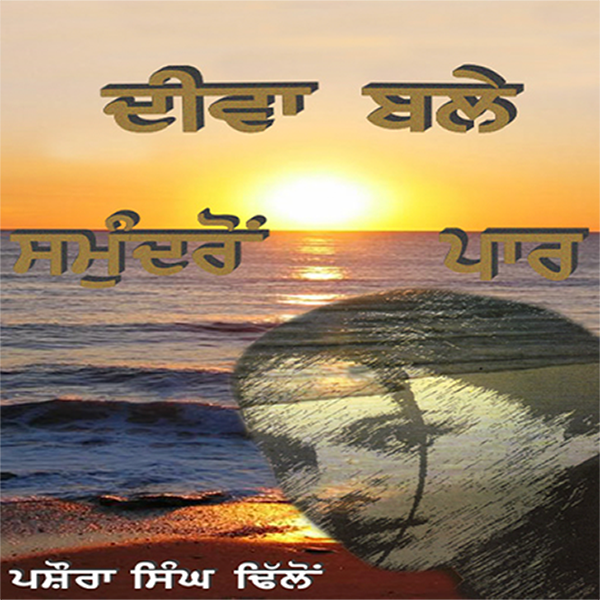
Environmental Impact Assessment reports based on alternate route studies which ought to be properly carried out by the professionals, fully understood by concerned parties, and made public under the Right to Information Act (RTI) are rarely adhered to in countries like India. Consequently, planting of replacement trees, which ought to be organized before the felling or axing should begin, hardly catches up even years later. The native trees such as Tahli, Kikkar, Neem, Pipal, Bohrr and others are replaced by fast growing species such as eucalyptus and poplar for quick effect. This may look good for the overflying politician in a helicopter in the short term but it offers no refuge and little solace for the insect and the dependent bird life. Hence my poems, ‘Piplan de sung Bohrr Gva Lei… and ‘Umber di Shehzadi de Naa’ published in my book ‘Diva Bale Samundron Paar’ were written in the same vein.
This past weekend, I had the chance to discuss some of these issues with S. Surjit Singh Rakhra, President of the Oversees Akali Dal, currently visiting California at S. Charanjit Singh Batth’s residence near Woodward Lake in Fresno. His views on this subject were not new and mirrored what seems to be the general consensus: First, let India catch up to other countries in terms of technology, industry, and food. Then worry about the environmental damage. But getting up to speed for a nation delayed is one thing and is perfectly understandable for the respective governments to show to its people the quick results. But hoping to coming back and clean up the mess left behind later is an unrealistic goal. How can a century old bohrr (banyan) tree be uncut? How do we reverse the effects of air pollution and illhealth caused by air polluting vehicles, or industrial waste in our rivers and oceans by companies held unaccountable for their actions? There are, of course, steps that can be taken in the right direction, but many environmental problems such as groundwater pollution are simply irreversible.

Baba Balbir Singh Seechewal
It is not that the true picture has not been painted before the release of Mann’s video. The more poignant question to ask is where do we go from here? The only person today, who is brave and resourceful enough to catch the bull by the horn – so to speak – appears to be Baba Balbir Singh Seechewal, a Punjabi eco-activist. By combining his assiduously cultivated self-help philosophy with the environmental essence of the Gurbani, Seechewal has successfully reinstated the 110-miles long Bein rivulet by his own design. A more scientific approach however, is adopted and vigorously advocated by Jaito based environmental community action group called Kheti Virasat Mission (KVM) in Punjab. They appear to have initiated some innovative and systematic survey data collection work in the Malwa Belt infested with mysterious diseases apparently due to environmental degradation. Maybe these kinds of initiatives and awareness at the grass root level are the only way forward to shame the present day rulers, policy makers and the ruled alike. Your thoughts?
Popularity: 68% [?]
The Chandigarh That Was
Aug 11th
Forty-two years ago, in 1968, I wrote my maiden poem ‘Rooh Mere Punjab Di’ for the maiden Rose Festival in Chandigarh and won special appreciation from the local community, specifically from Dr. M.S. Randhawa, the then Chief Commissioner of Chandigarh. On the simple stage set up at the grassy lawn under a modest tent erected for the occasion at the Sector 16 Chandigarh Rose Garden, I sang this poem with a great passion. In my heart and mind I genuinely felt as if I was singing this poem to that wonder girl of unparalleled beauty sitting right in the front row, who came of the age of sweet 16 that day. Chandigarh, later to be known as “City Beautiful” was born when they laid the foundation stone in 1952.
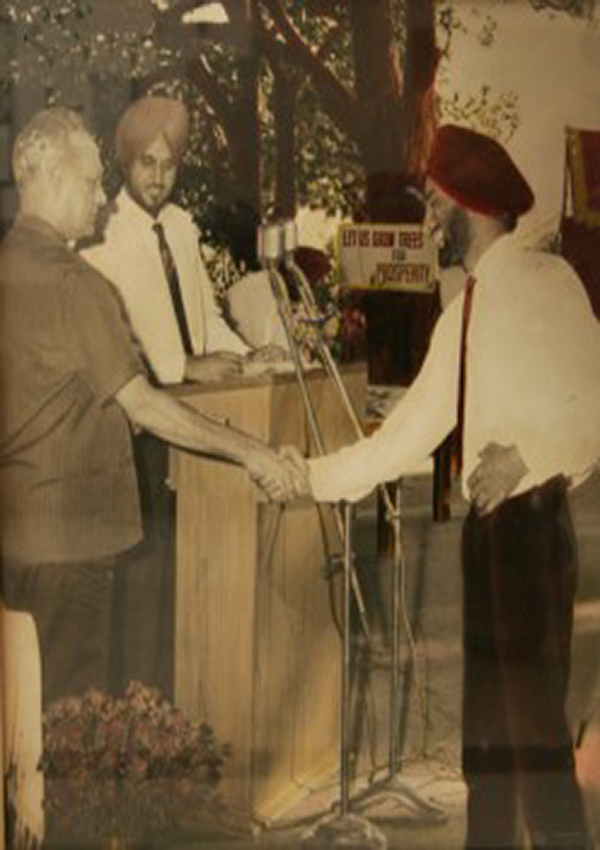
Dr. Randhawa who was presiding over the function was so moved by the poem that he rose up from his chair, walked up to me while I was still singing and put the perfumed rose garland presented to him earlier, around my neck whispering some kind words which are still music to my ears. That simple gesture must have made a lot of residents think and ponder about their connectivity with their new city. Performing on stage assured me that I didn’t have to choose between my dreams of being a poet/singer and a Landscape Architect (which I did a few years later). Read more about my life here.
Returning to the first ever Rose Festival started in 1968, there was no police security or extra traffic hold ups in spite of crowd control measures, car park overflows or pushing and shoving of any kind. Most residents simply walked to the festival place with families and children, the babus and high officials used their bikes, vespas or lamberettas and a few cars that were tucked away in the adjacent car park. There were no blaring loudspeakers or high volume Dj’s run music system disturbing the next door residents or the serenity of the leisure valley of which the Rose Garden was the focal point.
That Rose Festival of course, has now grown into a national celebration with all of the associated pomp and grandeur, chaos and confusion. They even offer camel rides. It may now be more “fun,” but it must be a nightmare for the traffic police, security officials as well as ordinary local residents especially children and the elderly. Especially the elderly who has seen better days as things were much simpler back then.
The city of Chandigarh was envisioned by Lee Corbusier in human form. As indicated above, I perceived this human form as a wonder girl who at the age of sweet sixteen in 1968, was blossoming into a young woman. The poem describes her unparalleled breathtaking beauty, vibrant youthfulness, exuberance and spirited promise for Punjab, the land of five rivers and for its deserving people. Blessed and protected from the evil eye by the great Himalayas, bathed in Sukhna Lake, the poem describes her decadent adornments as being made entirely of unique landscape plant material used to beautify Chandigarh.
My background in ornamental horticulture certainly shaped my view of the universe and in so doing, my poetry. After graduating from Khalsa College, Amritsar, my first job was working as a Horticultural Inspector at the then picturesque Moughal Gardens in Pinjore from 1962-1966, followed by a brief term with the capital project Chandigarh, before leaving for the United Kingdom. All these years I had the privilege of working closely under the inspiring supervision of Hardyal Singh Johl, now an accomplished landscaper of not only of Punjab but also of north India.
The Chandigarh of 1968 was not just any other city. It was the beautiful brand new capital city especially designed by the world renowned, French Architect Le-Corbusier, for Eastern Punjab. The Punjabis were filled with hope that it would somehow fill the void of losing its old crown Lahore, to West Punjab, now Pakistan, when in 1947 during the partition its soul: its people, land and waters were in fact, torn apart.
The Chandigarh of today is a different ball game for politicians. The curse of division on Punjab, which struck in 1947 does’nt seem to have gone away. Dark clouds of division have been looming large this time on its new capital city, when one of the neihbors, Haryana keep staking its claim also. Besides it is very quickly becoming a commercial hub with name brand stores like Armani and Gucci in Sector 17, overcrowded roads, parks and shrinking roundabouts, which once reinforced the sense of space, as garden city of the north and has already surpassed the population limits envisaged by Le-Corbusier.
People often ask me what inspired me to write ‘Rooh Mere Punjab Di.’ Any poet will find this a difficult question to answer because it can’t really be pinpointed to one specific inspiration. This is obviously a poem about Chandigarh, but it goes much deeper than that. Frankly speaking, I don’t know how and why I wrote it. Let the readers be the judge and arrive at their own conclusions. If you are interested to read it, download it at: PashauraSinghDhillon.com/punjabipoems
Popularity: 48% [?]
Introduction to Punjabi Poetry
Aug 10th
A Brief History:
Punjabi is the language spoken by all those who either live in Punjab or can trace their roots to the Punjab region. Punjab literally translates to the land of five rivers and at one time extended all the way from Delhi to Afghanistan. The day India celebrates its independence from British rule (August 15, 1947) is also the day when the state of Punjab suffered a historical loss of a tremendous proportion. West Punjab was acquired by Pakistan slicing Punjab more than in half and left Indian Punjab without a capital city (which used to be Lahore, now in Pakistan). This led to creating a new capital city in the form of Chandigarh. The second and equally stunning blow hit Punjab in 1966 when the allegedly majority Hindi speaking state of Haryana and part of Himachal Pradesh were carved out of it and Chandigarh became a Union Territory.
The Punjabi language is not the domain of any ethnic group or religion although the Guru Granth Sahib, the Sikh Holy Book, is also written in poetic Punjabi verse. Under the pretext of National unity, in the Punjab region of Pakistan and India, Punjabi is being systematically replaced with government support for Hindi/English or Urdu/English. There are many non-Hindi speaking states in South India where this Hindi/English combination proved unsuccessful because of a unified opposition by regional cultures who believe in unity through diversity. Punjab, unfortunately does not have the support from its neighboring states and has to rely on the global presence of Punjabis to keep their language and culture alive. According to a UNESCO report, if no positive steps are taken to preserve the Punjabi language, this thirteenth widely spoken language in the world will disappear in the next fifty years.
Punjabi Poetry At A Glance:
Like many other ancient languages, Punjabi has evolved through various stages and Punjabi poetry is perhaps as old as Punjab’s Indus Valley civilization. It has beautiful and complex ballads both from the past and contemporary Punjabi poetry can easily be compared to verses from Shakespearean sonnets, traditional Japanese haikus or modern forms of poetry. Stalwarts from the past have contributed significantly to Punjabi poetry like Waris Shah, Sultan Bahu, Bullhe Shah, Chandar Bhan and Ali Haidar amongst many others.Bhai Vir Singh, Puran Singh. Mohan Singh and Amrita Pritam are considered luminaries who pioneered the new era in Punjabi Poetry.
Properly defining the different styles and forms found in Punjabi poetry is an impossible task for someone who is not a literary historian. I will however provide you with an overview.
A Ghazal has its origins in the Arabic language and is traditionally considered a more scholarly form of poetry. A ghazal is a collection of shers which follow the rules of matla, maqta, behr, kaafiyaa and radif. A sher is a two lined poem capable of conveying a message without needing anything else to support it. It is therefore essentially a collection of these shers. There are many subcategories of a ghazal and the rules that govern its definition can get very complex. For example, a ghazal is an arrangement of lines whereby the first two lines rhyme with each other which in turn rhyme with the fourth, sixth, eighth and so forth. Each couplet conveys a complete message and may be interconnected to continue a theme. I told you it was confusing didn’t I? Any poem which does not pass the criteria to be considered a ghazal is called a kavita in Punjabi and a Nazm in Urdu.
My Favorite Poets:
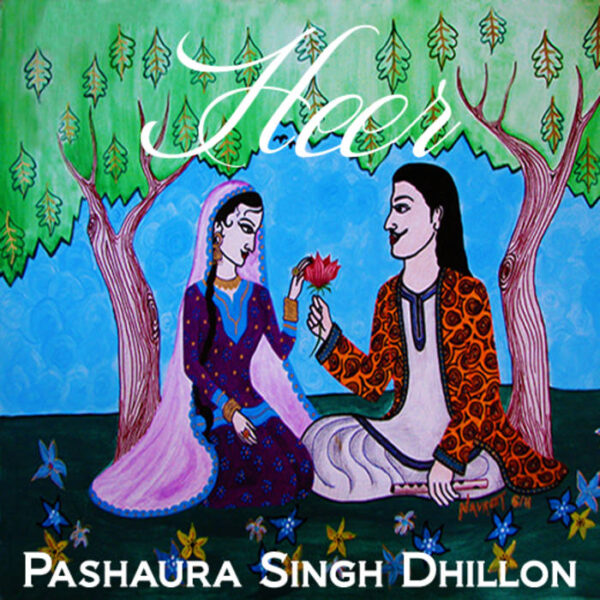
My favorites from the past include Bullhe Shah, Waris Shah, Ali Haider, and Sultan Bahu. Bulleh Shah was a Sufi poet who is most famous for his Kafis or short poems of about six stanzas and Ali Haidar is well known for his Si-harfis which are poems of 30 stanzas each beginning with a letter of the Persian alphabet. Waris Shah is best known for his rendition of the tragic love story of Heer and Ranjha.
Apart from my own poems I also sing selected poems from my favorite poets such as Amrita Pritam, Sukhwinder Amrit, Suikhbir Sandhu, Surjit Pattar, Dr. Jagtar, Shiv Kumar Batalvi, Baba Nazmi and on special request “Heer” by Waris Shah which is my all time favorite.
Popularity: 100% [?]
Presentation and Poem at Harvest Elementary School in Fresno, California
Aug 10th
After consulting with the school administration, Gurdeep Singh Shergill, a young elementary school teacher and DJ for the radio station I co-host (KBIF 900 every Sunday from 3-4 pm) invited me to make a presentation at Harvest Elementary School in Fresno.
The objective of my presentation was to help the students increase their awareness of diversity in the world around them and at school in particular. In the school culture as we know, if not properly supervised and kept under control, children who look different for whatever reason are picked on for no other reason than their looks or the way they speak. They may be excluded from play groups, beaten up, humiliated, or bullied because they don’t “fit in.” Sikh boys in this situation are especially vulnerable as they have long uncut hair that is tied in a bun on the top of their head (called a joora).
While I wanted the children to understand why Sikh boys and men look the way they do, the concept of my presentation which included a DVD slide show, was of a more universal message. Despite people’s different outward appearance, inside we are the same.
When Gurdeep first approached me with this presentation, I wasn’t quite sure what to expect as I had never taught a class before, but I was very pleased with the way Gurdeep ran his classes and the support the administration provided made everything run very smoothly. Apart from being a conscientious teacher, he is a community activist although he is too modest to admit it.
Gurdeep and the staff divided the students into two larger groups by combining grades 3 and 4 together. Then they did the same with grades 5 and 6. After half an hour of my presenting the basics of Sikhism and asking them some questions, we played them a DVD slideshow of my poem, “Pag Di Saanjh: A Tribute to the Sikh Turban.”
After showing the slideshow to each group, we started discussing some of the questions they had. Gurdeep (or Mr. Shergill as his students know him) showed his ingenuity one more time when he designed a very interesting question and answer format and a puzzle to recap all what was said and seen on the DVD. He had brought some small prizes such as pencils and stationary to reward the deserving candidates. The children loved it!
A copy of the coloring book ” The Boy with Long Hair” explaining Teaching Ideas and helpful Guidelines designed by educationist Mrs. Pushpinder Singh was also left with Gurdeep Shergill.
I remember being their age and hating to sit in one place for a long time so I was happy that most of them were attentive, listened patiently while they watched the DVD, and then asked questions in a very intelligent manner.
It gives me great hope that through efforts like these, and with staff like that of the Harvest Elementary School, exploring innovative avenues to create awareness of diversity at such an early stage in elementary schools where it all begins will go a long way. Inculcation of brief ethnic history of the diverse communities living in America in the curriculum Social Science course books at appropriate levels in schools will certainly help.
Popularity: 36% [?]
The Pinjore That Was
Aug 5th
In 1962, I had just graduated with a degree in horticulture from Khalsa College, Amritsar. Excited about my newly acquired qualifications, I decided to find a job by heading to a city I had never been to before: Chandigarh. I reached Chandigarh via the overnight train, Kalka Mail, from Amritsar. I walked into the Director of Agriculture’s office – I would later find out his name was Dr. Pritam Singh Deol – in Sector 17 the next day. The assistant, a lanky fellow named Gupta with an unusually chirpy and cheerful attitude, told me of a vacant Horticultural Inspector position at Pinjore Gardens or as it was known at the time, “Moughal Gardens, Pinjore.” I remember him telling me matter of factly that it was ” a good post.” I had never even heard of Pinjore let alone its gardens. I was just happy to have been offered a job!
With my joining orders safely tucked in my shirt pocket, I took a very bumpy ride via a P
epsu Roadways bus – which in those days ran between Patiala and Kalka. Pinjore itself was no more than a small village at that time with only one bus stop, but the driver, on my request, pulled the bus just in front of the walled gardens. Following the signboard and looking for the superintendant’s office, I hesitatingly entered the main gate of something which looked familiar in a strange sort of way. Its massive doors with protruding toothed spikes reminded me of a royal fort rather than a public garden. As soon as I entered the main gate and had the first glimpse, I was totally mesmerized by its breathtaking beauty that unfolded before my eyes. It was a different world. A world which I find hard to describe to someone who has not been there.
It was early morning and there were no visitors, at least not on the first terrace (there are seven terraces). The only people there were gardeners tending the flower beds. After asking one of them f
or directions to the superintendent’s office, I made my way towards the office which was housed in an old burj (one room minaret) on the first floor (next door to the panj pirs monument). The Superintendant, Hardyal Singh Johl, vigorously shook my hand as I handed him my joining papers. I wasn’t quite sure why he was so pleased to see me, but found out later that his wife, Gurbrinder K. Johl was from the same famous border village of Bhakna (of Deshbhagat Baba Sohan Singh) I was from!
My favorite part of Pinjore Gardens is at night from the roof of Rang Mahal on the first terrace where I have enjoyed looking out at the Chandigarh glow of light over the Shivalik Hills above the Surajpur Cement Factory. There was no Hindustan Machine Tool Factory then. Looking north I remember seeing the Kasauli Lights at the hilltop. At first I thought it only seemed like it was walking distance, but we walked there several times during my time at Pinjore (1962 – 1966).
The Moughal Gardens, Pinjore (now simply known as The Pinjore Gardens) had the imprints of Maharaja Patiala all over the place from plants to palaces called Mahals. There was no electrification behind the water falls, only earthern deevas were placed behind the falling waters in those carefully designed dwakha like pockets. Pinjore Garden was like a ‘glow worm’ amidst a surrounding dark countryside. Today those deevas have been replaced with electric bulbs, a small petting zoo stands in place of a small section of the garden. It was a different world then and it is another one now.
Popularity: 38% [?]
Photo Slideshow: Punjabi Folksong With Rajasthani Twist
Aug 3rd
In 2007, my son and daughter-in-law took a six month backpacking trip through India. As it happened, I was giving a public reading (Rubaroo) of my collection of poetry, “Diwa Bale Samundron Paar” at the Punjabi Sahit Kala Bhavan in Chandigarh during that time so we decided to take a short family trip to Rajasthan where neither my wife nor I had been before. We went to a remote area in Bikaner and went on an overnight camel safari. It was fun spending time with them and it was also fun to sing a traditional Punjabi song with some local Rajasthani musicians at the night camp. Here is a slideshow my son, Navdeep, and my daughter-in-law, Sona, created of that trip. Enjoy!
Popularity: 41% [?]


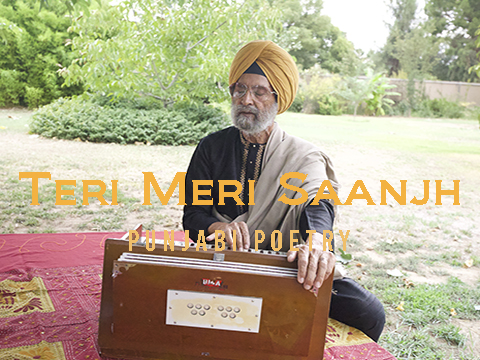
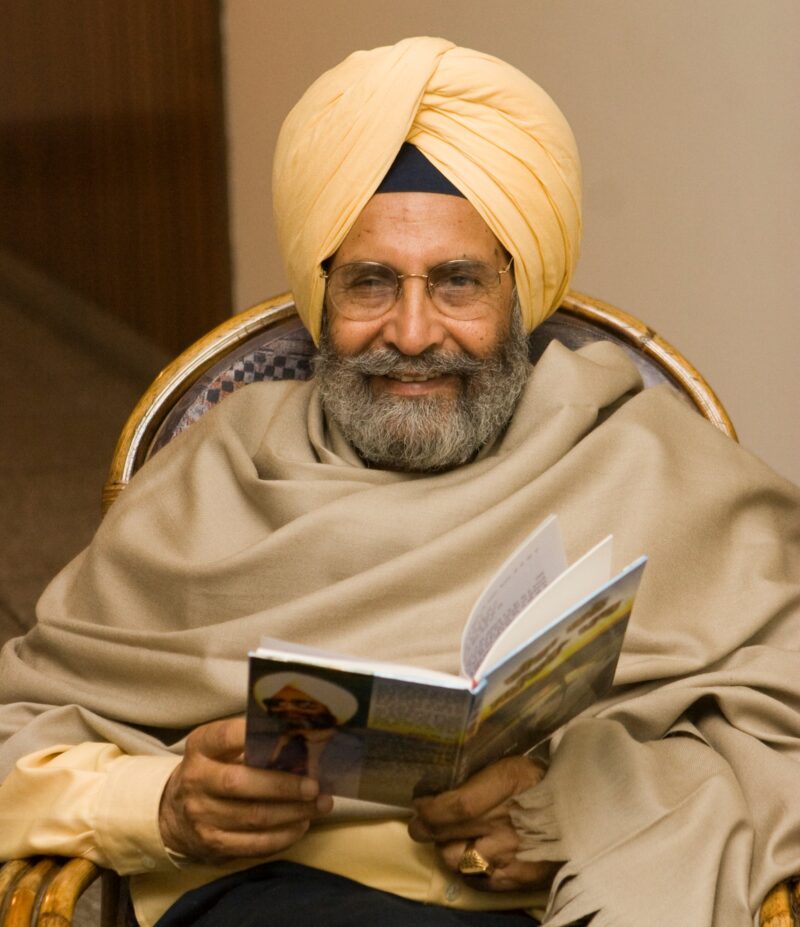
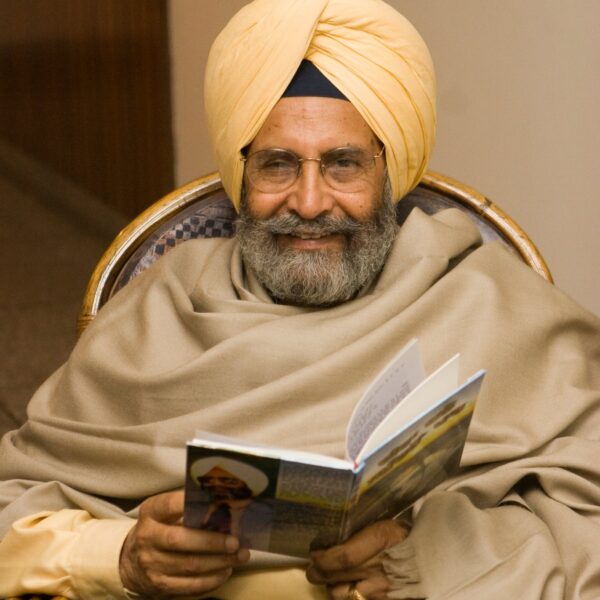
Pashaura Singh Dhillon is a poet and singer based in the Central Valley of California. He writes and sings in Punjabi about a variety of social issues ranging from human rights to the environment, and Sikh philosophy. He is the author of a collection of poetry, Diva Bale Sumundaron Paar (The Lamp Still Burns Across the Sea) and is currently a radio host in Fresno for Punjab News and Views. In addition to live performances, his poems have been featured on television programs, online media sites, and published in leading newspapers and magazines both in the United States and abroad, including Amritsar Times, Punjab News, Indo Canadian Times, Punjabi Tribune, Nawan Zamana, Preet Lari and Aks. View portfolio
Recent Comments